
Unintended Animal Seva and Karmic Humility -By S.Madhavakumar, Intuitive Astrologer
J Y O T I S H R E S E A R C H A R T I C L E & C A S E A N A LY S I S
An Analysis of Ketu, 6th and 8th House Periods, and Unexpected Shifts in Daily Routines.
In practical astrological consultations, we occasionally come across a very specific life event: an orthodox, religious person who has always maintained a strict physical distance from pets is suddenly required to care for a domestic animal. This goes beyond mere routine feeding and involves intimate, hands-on tasks like cleaning waste, bathing, and personal care. While this might seem like an unexpected family coincidence, classical Jyotish principles explain it quite clearly through the mechanics of the 6th house (Pashu Bhava), the 8th house, and the influence of Ketu.
1. CLASSICAL FOUNDATION OF ANIMALS AND MANUAL SERVICE
The foundation for evaluating domestic animals and daily chores rests on the 6th house (Riphu or Shatru Bhava).
Sage Parashara in Brihat Parashara Hora Shastra (BPHS) explicitly groups quadrupeds, domestic animals, and daily manual labor together under the 6th house:
BRIHAT PARASHARA HORA SHASTRA — CHAPTER 17, SLOKA 6
शत्रुव्रणाभिचारं च मातुलादिपशूस्तथा।
षष्ठभावाद्विजानीयात् सेवाकर्माणि सर्वशः॥
"Enemies, bodily wounds, maternal uncles, quadrupeds and domestic animals (Pashu), and all forms of manual service or daily chores (Seva Karma) must be judged from the 6th house."
While the 6th house governs the general presence of animals and daily duty, the primary planet signifying dogs and instinctual creatures is Ketu. Classical texts like Prashna Marga (Chapter 14) and Sarvartha Chintamani directly associate Ketu with dogs:
PRASHNA MARGA — CHAPTER 14
केतुः श्वानश्च कीटश्च ध्वजः शिखी तथैव च।
"Ketu signifies dogs (Shvana), insects, flags, and spiritual points of transformation."
When Ketu is activated together with the 6th house, its lord, or planets strongly connected with that house, animal care may become part of the native's daily karma. The form it takes depends on the houses involved: the 3rd may bring work through one's own hands, the 4th may bring the experience into the home, and the 8th may overturn long-established habits.
2. CASE STUDY: SYNCHRONIZED DASHA MANIFESTATIONS
To see how these classical principles work in practice, we can look at a case involving a client couple. Both individuals are devout, traditional, and had never handled or touched a pet dog throughout their lives. During a specific dasha period, they had to take full physical care of their son's pet dog, handling all daily feeding, walking, and cleaning duties hands-on.
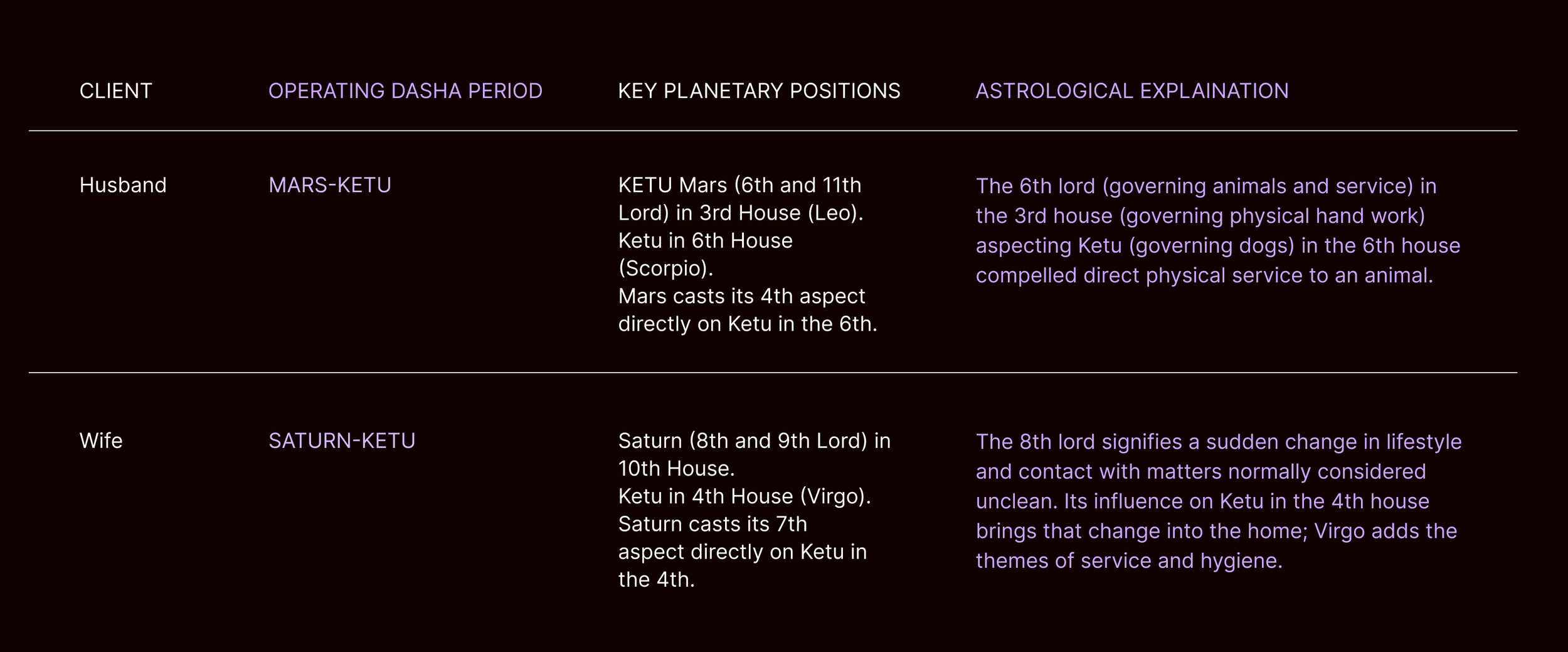
In the husband's chart, Mars rules the 6th house (animals and service) and sits in the 3rd house, which rules physical tasks done with one's own hands. Mars aspects Ketu in Scorpio in the 6th house. When the 6th lord and Mars energize Ketu in the 6th house, the person is pushed into active physical work involving a dog.
At the same time, the wife ran Saturn-Ketu. Saturn as the 8th lord rules sudden disruptions to normal routine, handling waste, and breaking personal comfort zones. Saturn aspects Ketu in Virgo (the natural 6th sign of daily care and hygiene) located in her 4th house of home life. This simultaneous trigger brought the animal directly into their living space and daily schedule.
This synchronization is important. A shared event need not appear through identical combinations in two horoscopes. Each chart may describe the person's distinct role in the same experience. Here, one chart emphasizes manual effort and animal service; the other emphasizes a sudden change within the household and the breaking of established norms.
3. THE PRINCIPLE OF RINANUBANDHA: WHY ANIMALS ENTER OUR LIVES
Why should an individual who never intended to care for an animal suddenly be compelled to do so? Classical karmic thought explains such encounters through Rinanubandha - a bond created by an unresolved debt or obligation. Puranic and Niti traditions describe family members, households, and animals as relationships through which earlier debts are experienced and settled.
GARUDA PURANA & NITI TREATISES
ऋणानुबन्धरूपेण पशुपत्नीसुतालयाः।
ऋणक्षये क्षयं यान्ति का तत्र परिदेवना॥
"Domestic animals (Pashu), spouses, children, and households are bound to us through past karmic debts (Rinanubandha). When that debt is fully settled (Rina-kshaye), the connection naturally ends. Why grieve or feel distressed about it?"
This sloka bridges planetary dasha triggers with karmic philosophy. The activation of Ketu along with the 6th and 8th lords creates a temporary window during which a specific past-life debt (Rinanubandha) to a creature must be cleared. Once the dasha finishes its role, the duty naturally resolves itself.
It is equally important to remember that astrology indicates the timing and nature of an experience; it does not diminish human responsibility. Whatever the karmic background, kindness, proper care, hygiene, and compassion remain the right response in the present moment.
4. SHASTRIC JUDGMENT: IS THIS DASHA IMPACT FAVORABLE OR UNFAVORABLE?
From the classical standpoint, the result is mixed at the outer level but constructive at the inner level. The experience may be physically uncomfortable and mentally unsettling, especially for someone whose religious or personal habits have always required distance from animals. Yet the same experience can become spiritually beneficial because it demands service without preference and care without expectation.
PHALADEEPIKA — CHAPTER 20 (DASHA PHALA)
केतोरन्तर्दशायाम्... पराचार्यं च सन्तप्तो मनस्तापं च विन्दति॥
"During Ketu Antardasha, a person experiences servitude or caring for others' needs (Paracharya), temporary mental discomfort, and the bending of personal pride."
Materially, the texts view this as a period of physical effort (Klesh) because it requires breaking long-held habits of personal distance and ritual purity. However, from a karmic perspective, caring for an animal ruled by Ketu is considered a powerful way to clear ancestral and planetary debts.
MAHABHARATA — MAHAPRASTHANIKA PARVA
श्वानरूपधरो धर्मः साक्षाद् एष सनातनः।
"Dharma itself took the form of a dog to test Yudhishthira, showing that protecting and caring for an animal is a fundamental expression of Dharma."
Traditional remedial practice also regards feeding, protecting, and caring for dogs as a way of harmonising difficult expressions of Ketu and Saturn. The remedy is meaningful not because the animal is used as an instrument, but because genuine care softens fear, pride, aversion, and indifference.
FINAL ANALYSIS
From a strict shastric perspective, performing animal service during a Mars-Ketu or Saturn-Ketu dasha clears long-standing karmic accounts. As the Garuda Purana points out, settling a Rinanubandha removes personal pride (Deha Abhimana) and satisfies both Saturn and Ketu, transforming what feels like an inconvenient chore into a meaningful act of spiritual purification.
The event is therefore neither simply good nor simply bad. Its outer form may be demanding, but its deeper purpose may be cleansing. In Jyotisha, the highest reading of a difficult period is not merely to predict discomfort, but to recognise the dharma hidden within it.
Disclaimer: These views are purely personal. I do not claim perfection, as only God is perfect.
Please contact the undersigned on askmahdeva@gmail.com for personal chart reading. Visit www.askmahdeva.com and read the blog freely.
Contact S Madhavakumar
Mobile: (91)9513812323