
Planetary Influences on Virility and Bed Comforts in Jyotișa
An Exploration with Sanskrit References
Abstract
This scholarly paper explores classical Jyotiṣa principles concerning sexual potency (virility or vīrya śakti) and bed comforts (śayana sukha or coital pleasures), pivotal elements in marital harmony and compatibility assessments. Drawing from foundational texts such as Bṛhat Parāśara Horā Śāstra (BPHS), Phaladīpikā by Mantreśvara, Sārāvalī by Kalyāṇa Varma, and Jātaka Pārijāta by Vaidyanātha Dīkṣita, the analysis addresses key themes: (a) the role of Venus and malefics/benefics in the 8th house for virility; (b) hermaphrodite grahas (Mercury, Saturn, Rāhu, Ketu) in the 12th house distorting intimacy; (c) Venus in the 12th house enhancing or diminishing pleasures; and (d) Rāhu's amplification of desires in the 12th. Original Sanskrit ślokas are cited with translations for authenticity, alongside illustrative chart examples and a comparative table. Special emphasis is placed on these factors' implications for marriage chart matching (e.g., via Upapada Lagna and Navāṁśa) and mitigating conditions that reduce doṣas, such as planetary dignity and benefic aspects. This work bridges śāstra (scriptural authority) and prayoga (practical application), offering insights for astrologers evaluating vivāha compatibility.
Methodology
The study employs textual exegesis of primary Sanskrit Jyotiṣa classics, cross-referencing ślokas from BPHS (trans. R. Santhanam, 1984), Phaladīpikā (trans. G.S. Kapoor, 1994), Sārāvalī (trans. R. Santhanam, 1996), and Jātaka Pārijāta (trans. V. Subramanya Shastri, 2004). Selections focus on houses 7th (kalatra, spouse), 8th (randra, longevity/virility), and 12th (vyaya, bed pleasures/losses), as these are central to marital doṣas. Interpretations integrate graha bala (strength via sign, aspect, dignity), bhāva contexts, and divisional charts (e.g., Navāṁśa for marital bliss). Comparative examples derive from hypothetical charts, emphasizing holistic judgment over isolated placements. Doṣa mitigations are derived from classical bhaṅga (cancellation) rules, ensuring fidelity to śāstrapramāṇa while noting regional sampradāyaprayoga variations.
Discussion
In Jyotiṣa, virility and bed comforts are not isolated but intertwined with marital longevity and compatibility. The 8th house governs āyu (longevity) and maithuna (union), while the 12th signifies śayana sukha and vyaya (expenditures, including libidinal). Afflictions here signal doṣas impacting spouse harmony, assessed in kuṇḍalī matching via Ashtakavarga, Upapada Lagna (marriage indicator), and Navāṁśa alignments. Weak Venus (kāraka for semen/vīrya) or malefics in these houses can cause incompatibility, such as mismatched desires or health issues, but mitigations abound.
1. Virility and the 8th House: Venus as Kāraka and Afflictions
Venus, the natural significator of vīrya and saubhāgya (marital bliss), when weakened in the 8th (randra bhāva), leads to klība (impotence) or diminished potency, disrupting marital union.
Śloka (BPHS, Ch. 14, Śl. 22): शुक्रेण हीनबलो नरः स्यात् क्लिबः स्त्रीषु न रमते ।
Translation: "A man with Venus bereft of strength becomes impotent and finds no delight in women."
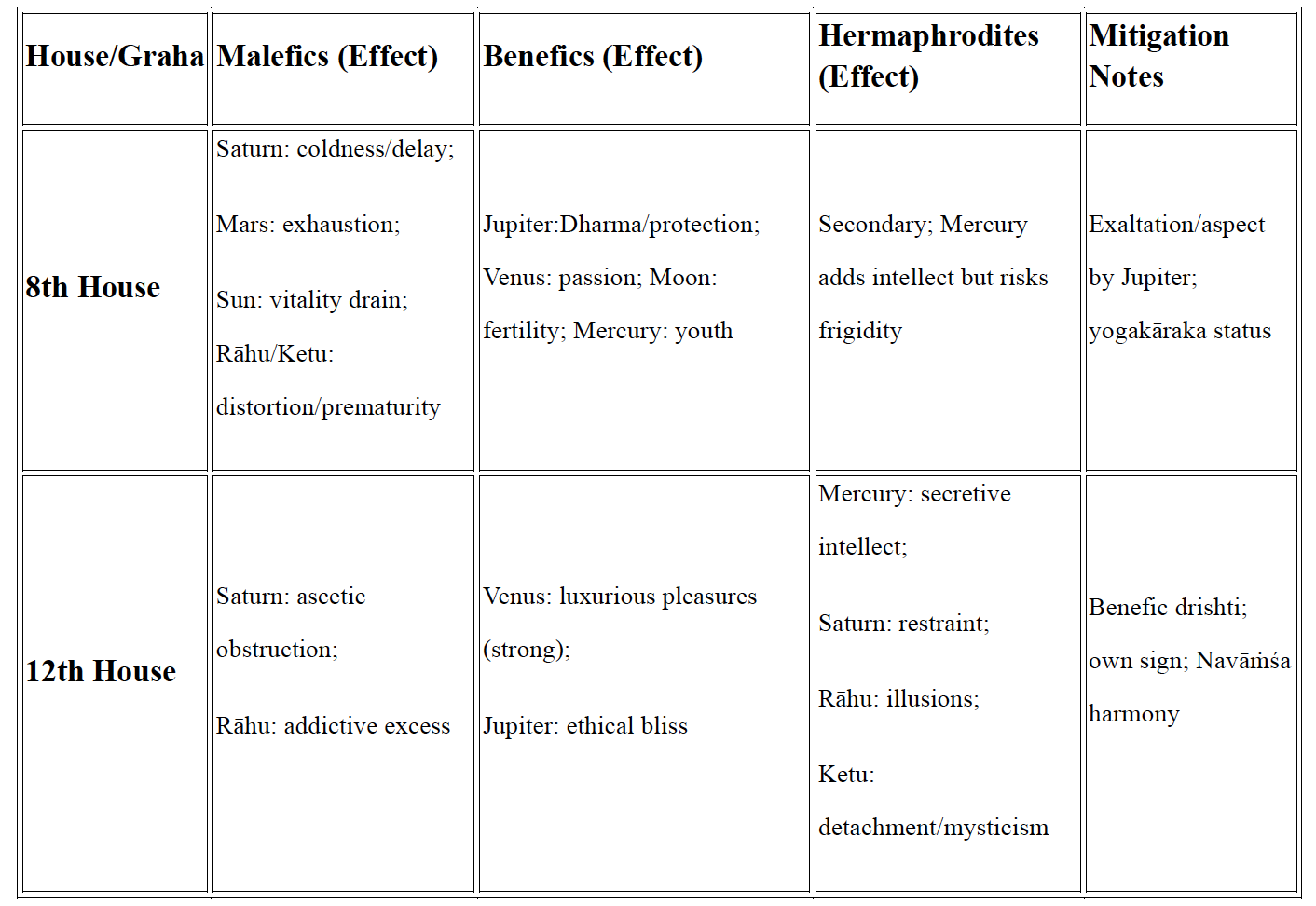
This affliction extends to marriage charts: a weak Venus in one's 8th may indicate mismatched vitality with the partner's 7th/12th, per Phaladīpikā (Ch. 12). Malefics exacerbate: Saturn induces śītalatā (coldness/delay); Mars, ati-uṣṇa (excessive heat leading to exhaustion); Sun, vitality drain; Rāhu/Ketu, distorted functions like premature issues. Malefics in the 8th or severe affliction to Venus during operative daśā may manifest as reduced potency, delayed arousal, exhaustion, or disharmony rather than literal impotence.
Conversely, benefics protect: Jupiter (guru) safeguards via dharma; strong Venus ignites passion; Moon fosters fertility; Mercury imparts youthful vigor.
Śloka (Sārāvalī, Ch. 30, Śl. 15): अष्टमे पापग्रहाः पुरुषस्य मैथुनविघ्नं कुिवक्लि । शुभग्रहाः तु रक्षणं करोक्लि । Translation: "Malefics in the 8th cause obstruction to a man's coitus; benefics, however, provide protection."
Additional Point: In compatibility, if the 8th lord of one chart aspects the partner's Venus, it harmonizes energies (Jātaka Pārijāta, Ch. 8). Afflicted 8th in Navāṁśa signals doṣa in progeny or longevity.
Importantly, classical texts caution against declaring doṣa without confirming: • Graha bala (ṣaḍbala) • Rāśi and Navāṁśa dignity • Benefic aspects (especially Guru) • Daśā–bhukti activation
Mitigating Factors for 8th House Doṣas:
Venus in own/exalted sign (Taurus/Libra/Pisces) or aspected by Jupiter tempers weakness (BPHS, Ch. 27).
Yogakāraka status (e.g., Venus for Libra/Taurus Lagna) converts affliction to moderated vitality.
Benefic conjunctions (e.g., Moon-Venus) enhance fertility; mutual aspect from partner's strong Mars balances heat/cold.
No doṣa if 8th lord exalted or in kendra from Upapada Lagna.
It should be noted that no single placement should be judged in isolation and entire chart must be seen for final view on this matter.
2. Hermaphrodite Grahas in the 12th House: Distortions of Intimacy
The 12th (vyaya bhāva) rules hidden pleasures and losses; hermaphrodite (napuṁsaka) grahas—Mercury (Budha, intellect), Saturn (Śani, restraint), Rāhu (illusion), Ketu (detachment)—here warp śayana sukha, leading to unconventional or diminished expressions, crucial for assessing marital secrecy or dissatisfaction.
Śloka (Sārāvalī, Ch. 2, Śl. 8): सूर्वः कुजः गुरुः पुंसः, चन्द्रः शुक्रः क्लस्त्रर्ः स्मृताः । बुधश्च शवन राहुश्च नपुंसकाः प्रकीवतवताः ॥
Translation: "Sun, Mars, Jupiter are male; Moon, Venus female; Mercury, Saturn, Rāhu, Ketu are declared eunuch (hermaphrodite)."
Mercury: Intellectualizes intimacy, fostering secrecy or unconventional kinks (Phaladīpikā, Ch. 12: overthinking leads to frigidity).
Saturn: Induces asceticism, sleep disorders, or erectile delays (restricts).
Rāhu: Fuels exotic/addictive pursuits, risking scandals in marriage, exaggerates.
Ketu: Promotes detachment, mystical dreams over physical union, dissolves desire.
Note that these placements often indicate psychological or karmic patterns rather than physical incapacity. When supported by benefics or strong Navāṁśa placements, they may manifest as tantra, celibacy by choice, or sublimated creativity.
Śloka (Phaladīpikā, Ch. 12, Śl. 28): शवनराहुकृतं दुःखं शर्नसुखविघ्नकम् ॥
Translation: "Saturn and Rāhu in the 12th cause misery, obstructing bed comforts."
In compatibility, napuṁsaka in one's 12th afflicting partner's 7th lord signals mismatched libidos (BPHS, Ch. 25).
Additional Point: Ketu here, if with Moon, indicates past-life karmic detachment, reducing marital passion but aiding spiritual bonds (Jātaka Pārijāta, Ch. 9).
Mitigating Factors:
Aspect from Venus/Jupiter softens distortions (e.g., Mercury-Venus: playful intellect).
Own sign placement (e.g., Saturn in Capricorn) channels restraint productively.
In Navāṁśa, if conjoined benefics, transforms to tantric harmony.
3. Venus in the 12th House: Pleasures and Perils
Venus in vyaya often amplifies bed luxuries but risks excess expenditure or dissatisfaction, varying by dignity—key for evaluating spouse's relational depth.
Śloka (Phaladīpikā, Ch. 12, Śl. 19): व्यर्स्थे शुक्रे नरो भिवत स्त्रीवप्रर्ः शर्नसुखी च ।
Translation: "Venus in the 12th makes a man fond of women and enjoyer of bed comforts."
Strong Venus (own/exalted, unafflicted) yields opulent pleasures, spouse fondness; weak (debilitated in Virgo, malefic aspects) breeds coldness or profligacy.
Additional Point: In marriage matching, exalted Venus here enhances Upapada's bliss but afflicted Venus warns of hidden affairs (Sārāvalī, Ch. 34).
Mitigating Factors:
Jupiter's aspect ensures ethical indulgence.
In friendly signs (e.g., Pisces), converts to charitable sensuality.
Mutual placement with partner's strong 12th lord neutralizes excess.
It is important to add that exalted or vargottama Venus in the 12th is considered auspicious for marital pleasure, artistic refinement, and affectionate spouses, especially when the Lagna is strong.
4. Rāhu in the 12th House: Amplified Desires and Unconventionality
Rāhu, the chāyā graha of insatiable craving, in the 12th magnifies hidden urges, often leading to unnatural liaisons or mokṣa pursuits—vital for detecting karmic mismatches in charts.
Śloka (Sārāvalī, Ch. 30, Śl. 20): द्वादशे राहुः स्त्रीसंगविलासेऽवतशर्मासक्तो भिवत ।
Translation: "Rāhu in the 12th causes excessive attachment to women's dalliances."
Śloka (Jātaka Pārijāta, Ch. 14, Śl. 12): व्यर्स्थो राहुः स्त्रीसंगविलासे प्रिृवतं करोवत ।
Translation: "Rāhu in vyaya incites propensity for amorous indulgences."
Effects: Hyper-desire, secret scandals if afflicted; positively, mystical ecstasy. In compatibility, afflicts partner's Venus, signaling infidelity risks.
Additional Point: Rāhu with Ketu (kāla sarpa variant) here detaches from mundane sex, aiding spiritual unions (BPHS, Ch. 47).
Mitigating Factors:
• Saturn's conjunction grounds illusions.
Exalted in Taurus/Gemini, channels to foreign romantic gains.
Benefic drishti (e.g., Moon) purifies to devotional love.
Illustrative Chart Examples
Saturn in 8th (Leo Lagna): Coldness, impotence; mitigated by Jupiter aspect—moderated vitality (Sārāvalī).
Jupiter in 8th (Taurus Lagna): Protective passion, fertility boost.
Mercury in 12th (Aries Lagna, debilitated): Over-intellectualized secrecy; Venus aspect adds playfulness.
Venus in 12th (Pisces Lagna, exalted): Luxurious śayana sukha, spouse devotion.
Rāhu in 12th (Gemini Lagna): Addictive desires; Saturn conjunction curbs excess.
Ketu in 12th (Sagittarius Lagna): Detachment; Moon aspect fosters emotional mokṣa.
Compatibility Example: Male (Venus weak in 8th) with female (strong Venus in 12th)—harmonizes via mutual aspects, per Upapada.
Comparative Chart
Conclusion
Classical Jyotiṣa unveils a nuanced tapestry for virility and bed comforts, rooted in Venus' potency, 8th/12th dynamics, and graha natures—indispensable for vivāha compatibility, where doṣhas like klība or vyaya vikṛti signal mismatches but yield to mitigations via dignity, aspects, and divisional strengths. As BPHS (Ch. 80) affirms, "No graha is wholly malefic; context decrees." This paper urges practitioners to transcend fatalism, honoring śāstra's balance of karma and upāya (remedies like Venus stotra or dāna). For deeper marital counsel, integrate with Daśā and Gochara, fostering harmonious unions.
Jyotiṣa evaluates tendencies (pravṛtti), not certainties. As Parāśara repeatedly emphasizes, grahas indicate karma, while free will, remedies, and conscious conduct shape outcomes.
Important Note:
In Jyotiṣa, no planetary combination or Dosha should ever be interpreted in isolation, especially on sensitive matters such as virility and bed comforts. The indications discussed in this article are derived from classical texts and represent general principles that may manifest differently based on the overall strength of the horoscope. A complete and accurate assessment requires thorough examination of the full birth chart—including Lagna, Navāṁśa and other divisional charts, planetary dignities, aspects, Yogas, daśā periods, and transits—along with consideration of the native's karma and free will. Isolated placements can be significantly modified or nullified by compensating factors elsewhere in the chart. This write-up is intended solely for educational and study purposes, to deepen understanding of śāstric principles. Readers are strongly advised to consult qualified and experienced astrologers for personal chart analysis, as only an expert can provide balanced, context-specific guidance after holistic evaluation. No definitive conclusions should be drawn from partial information presented here.
Personal Note:
These are general predictive & indicative observations, and the actual results will depend on individual charts, planetary placements, radical movements of other celestial bodies, birth ascendants, and Rashi signs. Therefore, the outcomes cannot be generalized for all individual horoscopes.
Disclaimer:
These views are purely personal. I do not claim perfection, as only God is perfect.
Please contact the undersigned on askmahdeva@gmail.com for personal chart reading. Visit www.askmahdeva.com and read the blog freely.
Copying or reproducing the text in part or in full is strictly prohibited and matter is copyright protected.